

Recyclable packaging with barrier coating:
picking the right system
If you own packaging compliance, EPR reports and chill-chain complaints, you’re walking a tightrope. On one side, PPWR and EPR are pushing you towards fibre-first, sustainable packaging with strong recyclability. On the other, your dairies, ready meals and frozen food lines still need serious barrier properties or your shrink and recalls explode.
Globally, around 40% of plastic waste comes from packaging, with Europe at roughly 38% – so every step away from conventional plastic packaging has outsized impact. In the EU alone, 79.7 million tonnes of packaging waste were generated in 2023, or 177.8 kg per person, with almost 20% of that waste made up of plastic formats. At the same time, Europe already recycles close to 87% of paper and board packaging, far more than any other material, and aims to reach 90% by 2030 – while plastic packaging recycling still sits around 40% and struggles to grow. If you want a credible roadmap, fibre-first packaging solutions with smart barrier coating systems are the obvious place to start.
This guide sits under your broader environmentally friendly packaging pillar and complements the molded fiber packaging guide as the claims-safe barrier playbook. It’s written for EU Packaging Compliance & EPR Managers, Dairy & Chilled Food Packaging Leads and Procurement Managers who need more than slogans. We’ll cover:
- which barrier technologies (dispersion, bio-based, films) actually work for chilled, paper-based food packaging,
- what “design for recycling” really means for coated fibre and paper packaging,
- how to avoid failure modes like leaks, warping and delamination,
- how to test WVTR, OTR, OGR and heat sealing in a way QA and auditors trust, and
- how to write and document recyclable packaging claims that survive PPWR and retailer scrutiny.
Intrecore specialises in wet molded fibre packaging for food and retail brands across Europe, so this guide reflects what we’ve seen work in real projects – not just on slides.
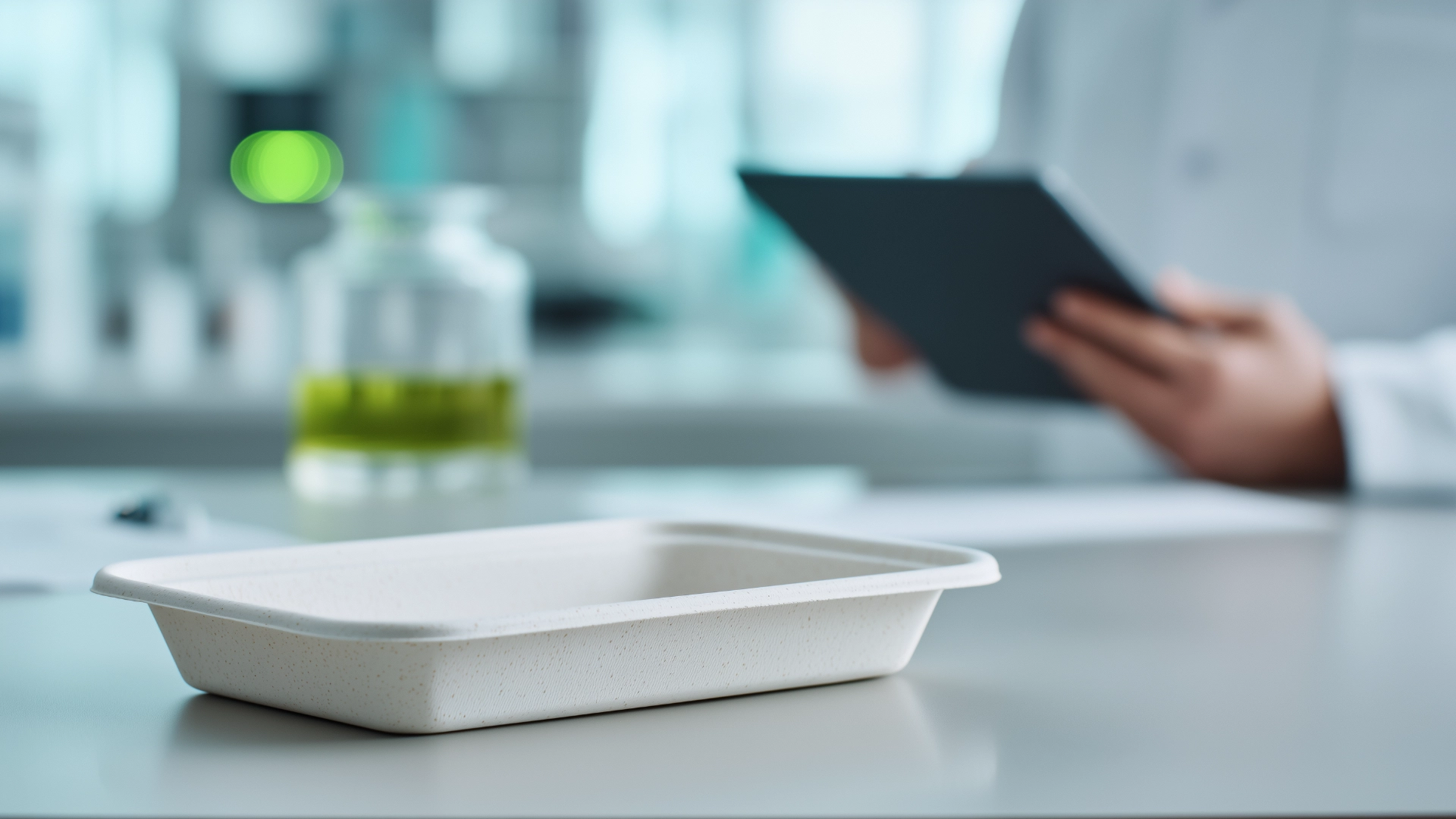
For the toughest chilled and greasy food applications, our default fibre platform in this guide is wet molded fibre: deep-draw trays with rounded rims that work exceptionally well with barrier coatings and heat sealing, while still offering strong potential for high paper-mill acceptance compared with coated board alone.
Throughout, think of this article as your “claims-safe barrier guide” – the practical companion when you choose a barrier coating system for a specific SKU in your fibre portfolio.
On this page:
Why barrier coatings matter for recyclable fibre
and paper packaging
For dairy, chilled meals, food service and e-commerce, plain fibre on its own is rarely enough. Yoghurt, cheese, sauces, ready meals and many food and beverage packaging formats all expose packs to condensation, fat, acids and mechanical stress. Without the right barrier layer, even strong board packaging can absorb moisture and oil and grease, lose stiffness, or allow oxygen ingress that wrecks shelf life and food safety.
Guidelines like the CEPI Paper-Based Packaging Recyclability Guidelines and the 4evergreen “Circularity by Design” guideline spell this out clearly: paper and board packaging is inherently recyclable, but coatings, films and other non-fibre elements must be specified so packs still disintegrate in pulpers and non-fibre can be removed without overloading screens or wastewater systems. That’s why modern coating technologies – especially water-based barrier coatings and sustainable barrier coatings – are becoming central to the packaging industry: they aim to deliver enough barrier performance for chilled and frozen food, while keeping structures compatible with high-yield paper recycling and future PPWR “design for recycling” criteria.
The real problem of packaging is not “paper vs plastic”. It’s poorly designed mixed materials – thick films, unknown coating chemistries and complex stacks that look green on shelf but quietly make packaging non-recyclable in practice. Your target is simple: fibre-first, mono-material where possible, with barrier coatings that do just enough and no more. For wet or greasy applications, you can then dive deeper into the dedicated water-resistant molded fiber guide.
Why wet molded fibre is a strong starting point for coated food trays
- Deep-draw shapes and rounded rims that give you robust edges for sealing and handling
- High potential for design-for-recycling when coatweights and chemistries are chosen with mills in mind
- Excellent fit for dairy, chilled ready meals and frozen applications where plastic trays are still dominant
Barrier systems compared:
dispersion, bio-based and plastic laminates
1. Dispersion and water-based barrier coatings
A dispersion coating is a thin, usually water-based layer applied directly onto wet molded fibre trays and paper or board substrates. Well-designed coatings like these can deliver:
- strong moisture resistance (lower WVTR),
- good grease / oil and grease resistance, and
- acceptable barrier to oxygen for many chilled SKUs,
while keeping the structure mostly fibre and compatible with paper recycling. When combined with the right substrate, they’re ideal for many dairy and chilled paper and board packaging formats, lids, paper cups and some flexible packaging applications.
2. Bio-based barriers from renewable materials
Bio-based barrier coatings use renewable materials – plant-based polymers, waxes or micro-fibrillated cellulose – to build the barrier layer. They support your sustainability story and can be used in food packaging once food contact and migration are proven. They’re attractive when you want sustainable and safe chemistry and a clean narrative on raw materials and sustainable and recyclable structures, but they still need proper repulpability and PPWR checks like any other system.
3. Thin plastic films, PE and high-barrier laminates
For some high barrier jobs – very fatty frozen food, long shelf-life sauces, aroma-critical or pharma packs – you may still need a thin PE or multi-layer film. Laminates can provide an excellent barrier to moisture and gases but:
- increase the use of plastic,
- raise plastic waste and packaging waste, and
- can create mixed materials that are hard to classify as recyclable paper in practice.
The pragmatic rule:
- Start from water-based coatings or bio-based stacks for most paper-based food packaging.
- Escalate to laminates only when barrier demands genuinely justify it.
- Document, in each spec, how the chosen system impacts recyclability of the packaging under PPWR and EPR.
- If you’re planning a wider migration away from plastic SKUs, connect this with the roadmap in “Switching to eco-friendly packaging: how to move from plastic to fibre without disrupting your lines”.
Design for recycling: mill acceptance, fibre yield and coated fibre
PPWR makes design for recycling a hard requirement: by 2030, all packaging on the EU market must be reusable or recyclable by design; by 2035 it must be “recyclable in practice and at scale”. For coated fibre and fiber-based packaging materials, that boils down to three questions.
1. Does the pack disintegrate in the pulper?
Coated trays, lids, coffee cups and moulded fibre parts must break down into individual fibres. For wet molded fibre trays, that means choosing barrier chemistries and coatweights that still let the three-dimensional shape break down quickly in the pulper instead of behaving like a rigid plastic shell. If coated paper or moulded pieces stay as plastic-rich flakes, you lose fibre yield and mills see you as material packaging waste rather than feedstock.
2. What happens to non-fibre components?
Heavy films and thick barrier coatings increase sludge. Design-for-recycling guidance from CEPI, CPI and the 4evergreen Circularity by Design guideline shows that fibre streams stay healthy when non-fibre elements are minimised and easy to remove.
3. Do you have proof – not assumptions?
If you describe a barrier-coated tray as “designed for paper recycling”, you increasingly need lab repulping and recyclability assessments aligned to CEPI/4evergreen or CPI protocols to back that up.
So, can moulded fibre packaging include a barrier and still be fully recyclable? Yes – when:
- barrier coatings enable disintegration and fibre release,
- non-fibre load stays in an acceptable range for mills, and
- you can point to independent DfR / recyclability test results, not just icons.
Taken seriously, DfR lets you leverage Europe’s high paper and board recycling rates and avoid quietly slipping into packaging non-recyclable territory while still using barrier coating technologies.
Failure modes and QA/QC:
leaks, warping and delamination
Switching from rigid plastic tubs or trays into coated fibre – especially wet molded fibre trays – doesn’t remove risk; it changes the failure modes. The main ones:
- Leaks and pinholes – often from under-cured barrier coatings, rough forming, or poor flange design.
- Warping and softening – when your packaging material can’t handle condensation or grease, particularly at corners and seals.
- Delamination and flaking – over-thick coatings or films peeling from the substrate, making packaging look cheap and creating particles.
To avoid these, build QA/QC around four pillars:
- Migration & functional barrier checks
Treat coated fibre as a serious food packaging material. Prove any functional barrier is working with relevant migration tests, especially when you move away from legacy plastics or PFAS-containing systems. - Seal integrity and heat-seal windows
In chilled dairy and ready meals, most real-world issues come from seals. Coated fibre must deliver consistent sealing to lidding films. Ask suppliers for seal-strength curves across temperatures and pressures, and include wet/contaminated flange tests. - Soak, edge-wicking and OGR
Run soak tests in water and oil and grease on full packs (including cut edges). OGR results translate directly into staining, softened walls and flange contamination – all classic failure drivers for coated wet molded fibre trays in the chill chain. - Forming and delamination checks
Combine tape tests, bending cycles and real forming trials. You want coatings to provide protection, not become a brittle skin that cracks under forming or denesting.
If QA treats coated fibre as a first-class packaging material instead of a “nice eco alternative”, you catch most leaks, warping and delamination before launch.
Testing barrier performance:
WVTR, OTR, OGR and heat sealing
You don’t need to design standards yourself, but you do need a clear testing brief. For coated fibre and fibre-based materials, three metrics matter most.
Moisture – WVTR
WVTR describes how much water vapour passes through a square metre of pack in 24 hours under defined conditions. For chilled dairy, ready meals and material for frozen products, WVTR is your main moisture control. When you set barrier requirements, tell suppliers:
- product type and fat content,
- target shelf life and chill-chain profile,
- expected condensation and stacking conditions.
This lets them choose suitable coatings like dispersion or other water-based barrier coatings, instead of over-engineering with thick films.
Oxygen – OTR / oxygen barrier
OTR measures your oxygen barrier. For high-fat or oxidation-sensitive SKUs, coated fibre plus a thin film may be required; for medium-risk chilled SKUs, a good barrier coating may be enough. Here, “just enough” OTR to protect the product is better than “max barrier” with unnecessary laminates.
Fats – OGR / oil & grease resistance
OGR is about how well a surface resists oil and grease penetration. For dairy, chilled ready meals and paper-based food packaging, bad OGR means stains, softening and flange contamination. Good OGR makes coated fibre behave like a predictable rigid spec all the way to end of life.
Heat sealing on coated paper and moulded fibre
On many lines, the same barrier coating is also the seal layer. Here coatings play a double role: they must help protect food and also make the packaging seal reliably. Poor control can make the packaging leak or force you to slow lines.
Ask suppliers for:
- seal-strength curves across temperature / pressure / time,
- data for wet or contaminated flanges, and
- evidence on your actual machines, not just lab platens.
Capturing WVTR, OTR, OGR and sealing performance in one dashboard per SKU turns barrier coating decisions into a clear comparison of barrier solutions, not guesswork.
Claims, PPWR and documentation:
recyclability that survives audits
Under the EU Packaging and Packaging Waste Regulation (PPWR), claims like “recyclable packaging”, “sustainable packaging” or “alternatives to plastic” are no longer harmless badges; they are promises you have to substantiate.
How to write compliant recyclability claims in the EU
- Anchor claims to evidence, not intent.
If you say “designed for paper recycling” on a coated fibre tray, keep repulpability and recyclability reports (based on CEPI/4evergreen or CPI guidance) in your technical file. - Be precise about streams.
“Recyclable in paper streams where facilities exist” is safer than generic “eco-friendly”. Don’t promise a stream that doesn’t exist in key markets. - Separate reuse from recycling.
Only call formats reusable packaging or “packaging reusable” when you can show realistic loops and damage rates.
To strengthen the proof-point and avoid greenwashing, you can also lean on third-party marks detailed in Eco packaging certifications that prove your packaging is truly sustainable.
What documentation do you need for PPWR/EPR?
From each coating, board or moulded-fibre supplier, you should expect:
- detailed specs of all different materials in the structure (including any PE or films),
- food contact declarations and migration reports,
- WVTR / OTR / OGR and sealing data,
- recyclability / DfR assessments for paper and board packaging, and
- statements on PFAS and other restricted substances.
This is the bundle that turns innovative packaging concepts into something auditors, retailers and regulators can actually sign off – and it’s the same bundle discussed in more depth in your eco packaging certifications and microplastics in food packaging guides.
Case examples and trade-offs:
dairy, frozen, coffee cups and e-commerce
Let’s ground this in a few familiar scenarios where barrier coatings and fibre compete directly with legacy plastics.
Chilled dairy and desserts – coatings as default
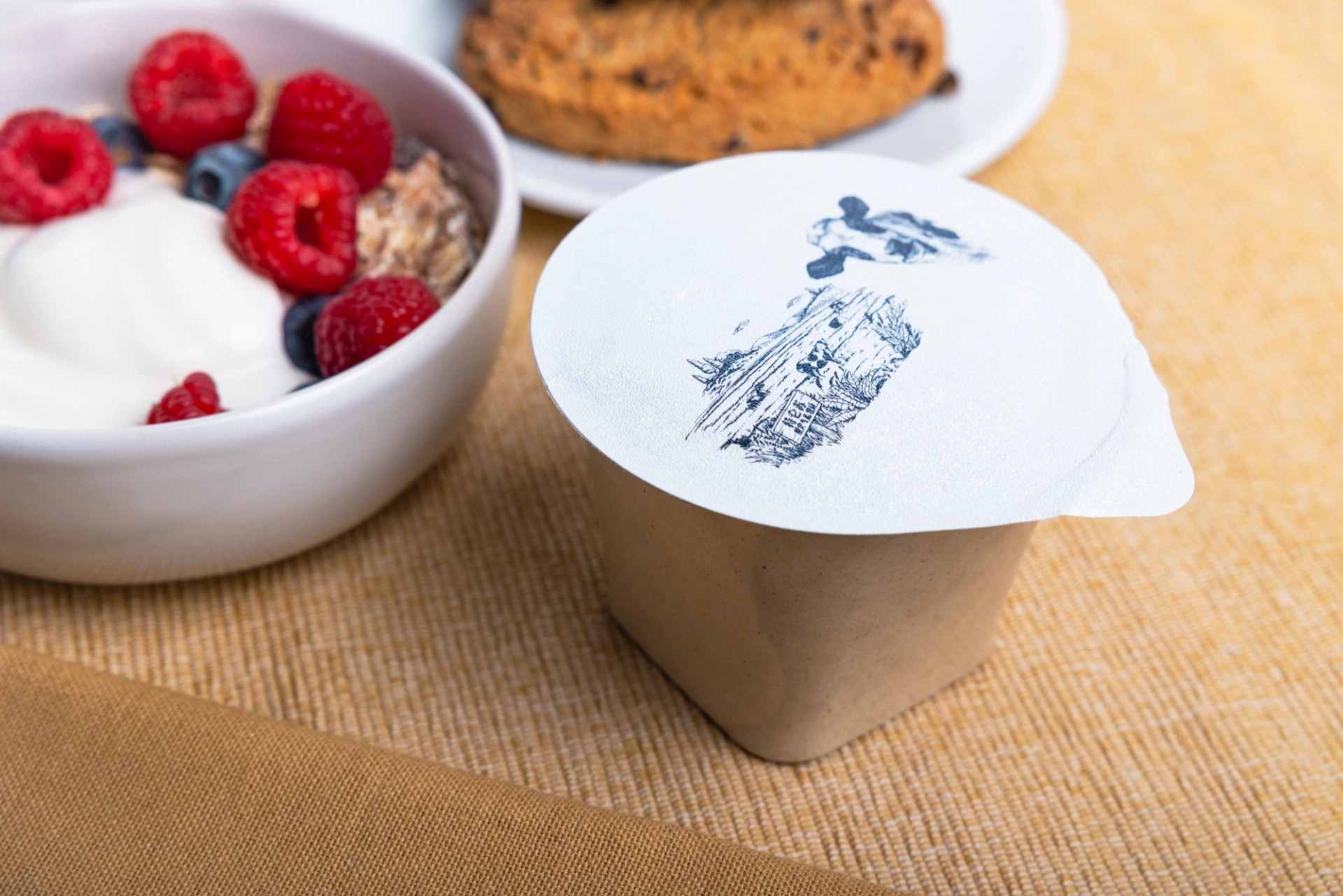
For yoghurts, puddings and fresh cheeses, PFAS-free coated wet molded fibre trays – and, where appropriate, coated board trays – usually deliver enough WVTR and OGR. You get:
- thin water-based or bio-based barrier coatings that keep trays compatible with recyclable paper streams,
- sealable flanges that run on existing lines, and
- a strong story on cutting single-use plastic tubs.
Here, barrier coatings help wet molded fibre become a real alternative to plastic tubs, and the wet molding platform in particular is explored in depth in Water-Resistant Molded Fiber: Can It Really Replace Plastic in Wet & Greasy Packaging?.
High-fat, long-life or frozen food – when films are still justified
For aggressive or long-life recipes – think lasagne with months of frozen shelf life – you may still need a thin film on top of a coated wet molded fibre or board tray; that’s where high-performance barrier coatings combine with a film to reach very low WVTR/OTR.
Yes, this increases the use of plastic and packaging waste complexity, but if you keep fibre share high and choose DfR-friendly films, it can be a defensible compromise under PPWR. Your DfR and microplastics strategy should be reinforced by the design patterns in the microplastics and nanoplastics in food packaging guide.
Coffee cups, paper cups and food service
Legacy coffee cups relied on thick plastic liners that made them hard to recycle. Newer water-based barrier coatings on cups and lids are coatings designed to fragment and detach in pulping, keeping fiber-based materials within high-yield paper recycling loops. For food service and on-the-go packaging market formats, they’re a powerful way to reduce single-use plastic without complex reuse systems.
E-commerce and inserts – fibre as default, coatings as light touch
In e-commerce, coatings play a lighter role: they make molded fibre inserts and other fibre packaging more robust against humidity and handling, avoiding bubble mailers and laminated mailers that mix materials like plastic films and paper – the kind of shift mapped in Switching to eco-friendly packaging.
Across all of these, the pattern is the same:
- Use light, repulpable barrier coatings where they keep fibre recyclable.
- Use laminates carefully and transparently, with PPWR-ready documentation.
- Keep your packaging solutions story focused on fibre and circularity, not just slightly “better” plastic.
Make fibre work for chilled and frozen – without guesswork
FAQ – recyclable packaging with barrier coating
Do barrier coatings reduce fibre yield or create rejects in recycling?
What’s the difference between dispersion coating and plastic lamination?
How can I achieve grease resistance without PFAS?
Can barrier-coated fibre packaging be used for chilled / cold-chain products?
How does PPWR affect coated and laminated packaging claims in the EU?
Explore more related content

Sustainable Packaging Design: How to Make Eco-Friendly Packaging Look Premium
Sustainable Packaging Design: How to Make Eco-Friendly Packaging Look PremiumFor beauty and retail brands, sustainable packaging design is about...
Eco packaging certifications that prove your packaging is truly sustainable
Eco packaging certifications that prove your packaging is truly sustainableIf you’re responsible for packaging, you’re surrounded by claims:...
Microplastics and Nanoplastics in Food Packaging: A Practical Guide for Food and Retail Packaging Teams
Microplastics and Nanoplastics in Food Packaging: A Practical Guide for Food and Retail Packaging TeamsMicroplastics in food packaging are no longer...