

Is pulp molding cost-effective for large-scale packaging?
Compare tooling costs, MOQs, and 12–36-month total cost of ownership against plastic,
with a practical break-even calculator for procurement teams.
This guide looks at what drives costs, where volume discounts come from, and how to compare European suppliers. You’ll also find a break-even calculation and a practical checklist to help you decide whether the numbers work for your project.
On this page:
Molded Pulp Packaging Costs:
Mold, Raw Material and Manufacturing
Engineering consultancy AFRY estimates that fiber accounts for 30–35% of production costs for a typical Type III molded fiber product [1]. In his 2020 PhD thesis on thermoformed molded pulp, DTU researcher Mattia Didone notes that drying energy costs may be 8–20 times those of the pre-forming stage [2]. This is a process-specific research estimate—not a universal ratio for all molded pulp manufacturing methods.
That makes manufacturing efficiency worth investigating before negotiating price. A complex mold, unnecessary finishing, or inconsistent recycled paper can increase costs through longer cycles and higher reject rates. Ask suppliers which specifications are driving their quotation—and which could be adjusted without compromising performance.
Pulp Molding at Scale:
Mold Design, Production and Efficiency
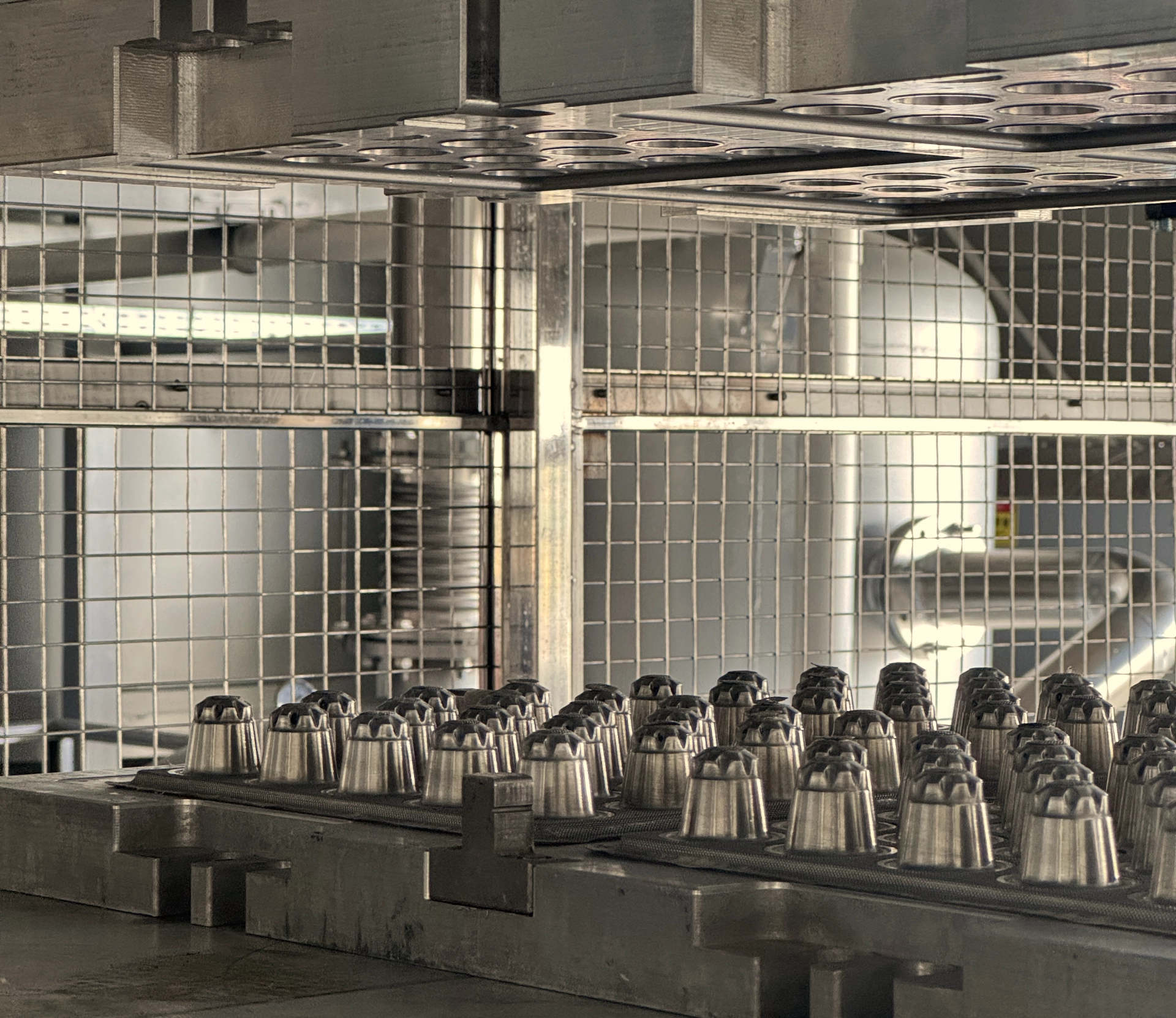
Large orders help spread mold tooling investment across more units. But production volume isn’t the whole story: producing molded pulp products efficiently depends on repeatable quality as well as output.
Multi-cavity molds increase output per cycle. Better dewatering, optimized drying, and consistent production yield reduce energy use and rejected parts. Packaging design matters too: complex shapes and sizes can slow molded pulp production, while simpler geometry may improve efficiency without compromising product protection.
Packaging manufacturing efficiency depends on mold design and technology. Transfer molding, including dry-press production routes, can suit high-volume protective packaging products, while wet-press technology may justify higher processing costs for demanding appearance or precision requirements. The right choice depends on your packaging needs, not simply the lowest quoted unit price.
For procurement teams choosing packaging, the useful question is whether simpler mold geometry can deliver the same performance at a lower cost per accepted part. The versatility of molded pulp can support both industrial packaging and suitable food packaging designs, provided product-specific requirements are validated.
Molded Pulp Packaging in Europe:
MOQ, Lead Times and Price Breaks
There’s no standard European MOQ for custom molded pulp packaging. Minimum quantities depend on mold tooling, part dimensions, supplier capacity, and order consistency. The use of molded pulp for a protective insert may have different volume economics from a food-contact tray.
For context, US manufacturer Fibreform states that custom products usually require at least 30,000 units in annual demand [3]. That’s a supplier-specific example, not a European industry benchmark.
When requesting quotes from pulp molding packaging manufacturers in Europe, compare annual volumes of 50,000, 250,000, and 1 million units. These are useful quotation scenarios, not guaranteed price-break thresholds.
Ask separately about prototype, pilot, and serial-production lead times. Minimum delivery quantities matter too. A discount is less attractive when it leaves you paying to store several months of inventory.
For the manufacturing basics, see Intrecore’s pulp molding guide.
Molded Pulp Packaging vs. Plastic: 12–36-Month TCO
A proper TCO comparison considers the full packaging solution, not just the packaging material. Shipping and storage costs, packaging waste management, line efficiency, and country-specific EPR fees can change which packaging option is more economical over 12–36 months.
| Cost factor | What to compare |
| Mold tooling | Initial investment, maintenance, replacement |
| Unit costs | Materials, manufacturing, finishing |
| Logistics | Freight, pallet utilization, warehousing |
| EPR and end-of-life | Country-specific fees, disposal costs |
| Operations | Rejects, damage, line speed, rework |
TCO = Tooling + (Unit Price × Volume) + Freight + EPR + Quality and Operational Costs
For co-packers, denesting deserves attention. A cheaper insert may cost more overall if inconsistent dimensions slow packing lines or increase rejects.
EU Regulation 2025/40 also sets packaging and producer-responsibility requirements [4]. Actual EPR fees vary by national scheme and packaging characteristics. A recyclable product does not automatically carry lower fees.
Compared to traditional materials, the benefits of molded pulp depend on the complete packaging system. Sustainable packaging materials and sustainable packaging solutions may reduce some environmental impacts, but sourcing, manufacturing, transit, recycling, and landfill costs still require assessment. Some molded pulp products may be biodegradable or compostable under specified conditions; these claims require evidence for the finished packaging and coatings. Paper packaging is not automatically the cheapest option.
Sustainable Packaging Solutions:
Financing Molded Pulp Adoption
- Tooling amortization: spreading agreed mold costs across future unit prices.
- Shared or standardized tooling: reducing upfront investment where compatible designs and ownership terms allow.
- Scheduled deliveries: negotiating annual volumes without receiving every unit at once.
None of these options should be assumed available. Clarify who owns the mold, what happens if demand falls, and whether outstanding tooling charges remain payable.
For the wider transition process, see Switching to Eco-Friendly Packaging.
Molded Pulp Supply Chain Risks: Trials, QA and Dual Sourcing
These should cover dimensions, stacking, denesting, moisture-related deformation, and relevant transport or line trials. For critical SKUs, assess dual-sourcing feasibility and document how the supplier handles tooling revisions or production interruptions.
RFQ checklist for comparing molded pulp suppliers:
- Annual volume, MOQ, unit prices, and price-break thresholds.
- Mold ownership, maintenance, replacement, and transfer rights.
- Pilot acceptance criteria, QA documentation, delivery terms, and contingency capacity.
European manufacturing can make collaboration and site visits easier, but transport costs and delivery performance still need checking.
Intrecore’s EU manufacturing and R&D operations support dry-press and wet-press packaging development, controlled revisions, and prototype-to-pilot validation.
Pulp Molding ROI: Mold Tooling Costs and Break-Even
Break-even volume = Additional upfront investment ÷ Net savings per unit
Consider a hypothetical procurement scenario—not an Intrecore customer case: a buyer compares a molded pulp insert with a thermoformed plastic alternative. The molded pulp option requires €12,000 more upfront tooling, but the assumed recurring net saving is €0.04 per unit after relevant operating cost differences. The figures show the calculation only; they are not measured Intrecore results.
At 250,000 units annually, the break-even point is 300,000 units, reached after approximately 14.4 months.
| Time horizon | Cumulative volume | Net result after extra tooling |
| 12 months | 250,000 | −€2,000 |
| 24 months | 500,000 | +€8,000 |
| 36 months | 750,000 | +€18,000 |
The figures assume stable demand, no discounting, and unchanged net savings per unit. They are illustrative, not supplier quotations. If recurring costs are higher rather than lower, increasing volume alone will not recover the additional investment.
Use the interactive calculator below to test different tooling costs, annual volumes, and net savings.
Molded Pulp Break-Even Calculator
Estimate your tooling payback and 12–36-month net cost difference versus plastic packaging.Please enter valid numbers. Tooling and annual volume cannot be negative.
Estimated net financial result compared with plastic
At your current annual volume, the additional tooling cost is recovered after approximately 14.4 months.
When Does Molded Pulp Make Financial Sense?
Molded pulp packaging can compete with plastic at scale, but the numbers must work for your project. Mold tooling, production efficiency, and logistics determine whether the investment pays off.
Before signing, compare suppliers on equal terms and check your break-even volume against realistic demand. The right packaging solution should meet your budget, operational needs, and sustainability goals.
Ready to evaluate molded pulp packaging for your project?
Frequently Asked Questions About Pulp Molding Costs
How much does pulp molding tooling cost?
What is the typical MOQ for molded pulp packaging in Europe?
Is wet-press molded pulp more expensive than dry-press packaging?
Can SMEs reduce costs through shared tooling or phased orders?
How long does it take to recover the tooling investment?
Explore more related content

Sustainable Packaging Design: How to Make Eco-Friendly Packaging Look Premium
Sustainable Packaging Design: How to Make Eco-Friendly Packaging Look PremiumFor beauty and retail brands, sustainable packaging design is about...
Recyclable packaging with barrier coating: picking the right system
Recyclable packaging with barrier coating:picking the right systemIf you own packaging compliance, EPR reports and chill-chain complaints, you’re...
Eco packaging certifications that prove your packaging is truly sustainable
Eco packaging certifications that prove your packaging is truly sustainableIf you’re responsible for packaging, you’re surrounded by claims:...